Sunday, 24 August 2014

Cups of Clouds


"I waited in an unpretentious café at the corner of Dean Street and Old Compton Street called Torinos, which had been run for fourteen years by Mr and Mrs Minella from Italy and their son. It was pleasantly old-fashioned with tall, arched windows... It had wrought iron tables with marble tops, cups of proper coffee... you could talk for hours over a small cup of coffee and the Minellas did not mind. They were so anxious to keep their customers happy they kept their prices low and were rash enough to allow credit... The goodwill was reciprocated and the tables were usually crowded. There were dark Italians huddled in earnest discussions, suddenly bursting into furious argument... and several pale young artists and poets searching half-heartedly for jobs..."
                                        - Daniel Farson “Soho in the Fifites”, 1987.


Strangely enough, the first character in Fried Green Tomatoes was the café, and the town. I think a place can be as much a character in a novel as the people.
-       Fannie Flagg

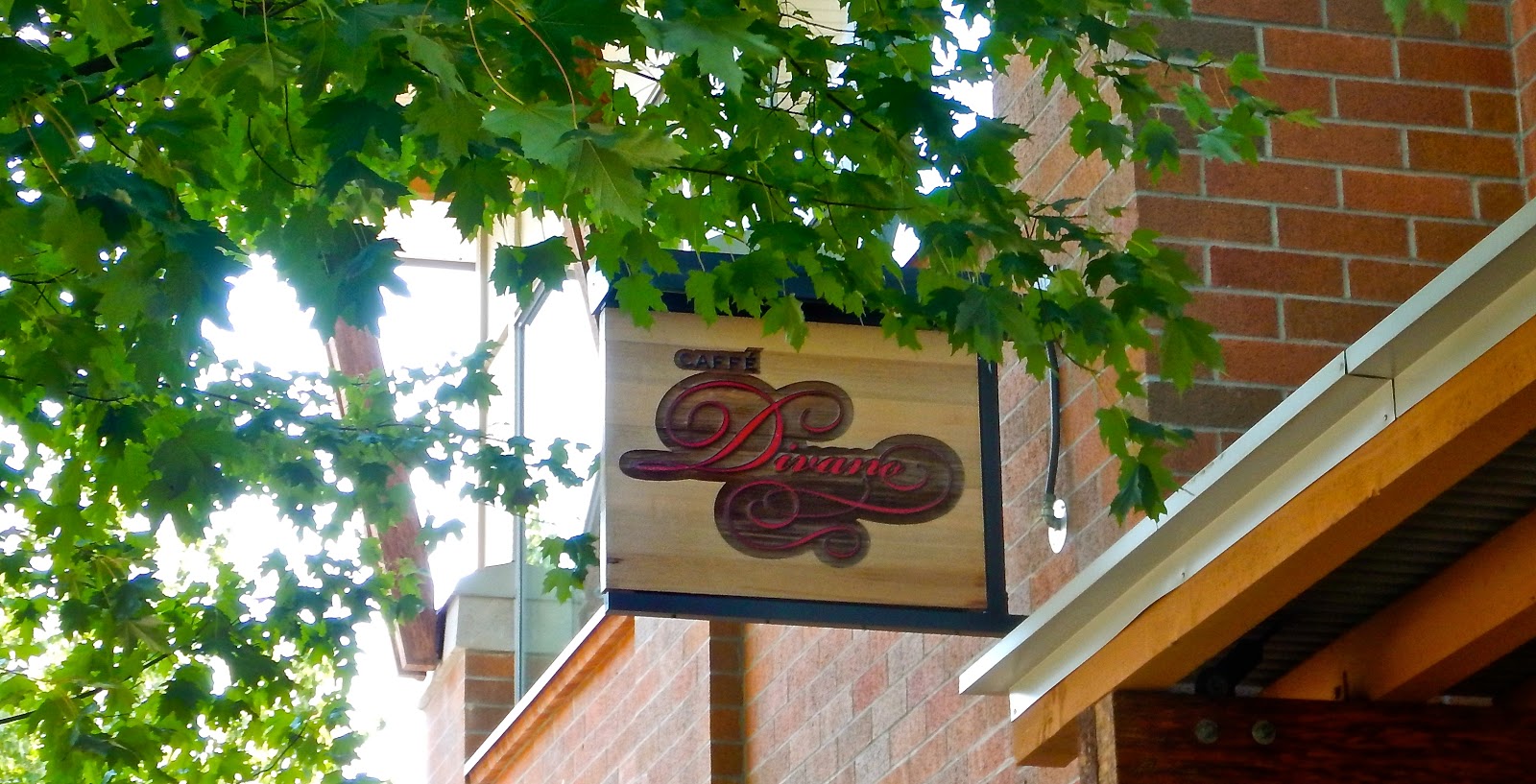
My place includes a café where we sometimes go for cappuccinos and people watching. They welcome dogs, as evidenced by the many dogs lounging around the outside tables or tied to various structures as their owners make their coffee orders. Large metal water dishes provide refreshment for canine visitors and, on hot days, the water is spiked with cubes of ice.  Dog cookies are free and plentiful.

This is one of the few coffee cafes that actually knows what a ‘dry’ cappuccino means, which is one of the many reasons we frequent it. One of the barristas is so excited when we show up, she says we make her day. Why? Because of the fact that we order dry cappuccinos.

“I get to create clouds”, she enthuses. “You let me make clouds for you!”

And, indeed, the cappuccinos are works of art, airy clouds virtually being kept in the cup by a mere spoon. Remove it and the froth would rise to the sky and take its place amongst the real cumulous, and cirrus, and mare's tails.

They let you sit forever. You can write, or muse, or people-watch. You can watch the curmudgeon Asian barrista draw incredible flowers, and trees, and fleur-de-lis on the top of lattes, a cynic with the heart of an artist. Or smell the fresh-baked creations of a chef-artist that understands the virtuosity of a truly poetic blueberry muffin.

A neighborhood café, a good café that authentically reflects its community, tends to be a centre of music, art, ideas – the place where people come together and share stories. We’ve started up conversations with people about their precocious toddlers, or their old, but lovable dogs, or whether their bike is Italian or American. Cyclists come to this café on the weekends, propping $3,000-dollar bikes against the hydrangeas. Mom n’ Babe groups on weekdays – looking for all the world like troupes of baboons as their babies cling to their backs, or fronts, or loll in their designer carriages.


We come to this particular café, in my place, for a lot of reasons. People-watching. Dog-watching. Narrative voyeurism. But mostly I come to this café because I love sipping mouthfuls of full-bodied, slightly bitter coffee through cumulous clouds.  


Friday, 22 August 2014

Old Car and Wet Dog


I also tend to like cars that need me. To me, cars are like old screen doors. I know that if I jiggle the latch and move it this way, it will open for me and no one else. And that's the kind of cars I like. So I'm the worst possible kind of consumer to do a test on. I like idiosyncratic things. . . . .
Jay Leno, Popular Mechanics, Feb. 2000
Cars are like rolling diaries, metal and plastic and paint tableaux of the last ten years of their drivers' lives ... every dent, every drooping slice of chrome, has a story behind it.
Jim Atkinson, Texas Monthly, "Heaven on Wheels," Sep. 1984
 At times, the only way to get to certain parts of my place is by car. Rikki Rondo fulfills that role for me. Old, not exactly beautiful, and funky. Funky not just in looks but also in smell, as Rikki has  been used to haul everything from garden  manure to (at one time, and all at once) six dogs. Some smells never go away. Even now, with only one dog, the almost permanent nose prints on the windows make me feel that I am driving in a perpetual fog, coupled with the fog of the miasma created by wet dog (rain or lake, it doesn’t matter).

I remember when we bought the car. The dealer went on and on about that feature or another. Eight cup holders!  Really.  Who actually uses eight cup holders? The DVD player built into the ceiling of the car. We didn’t want a DVD player. It came as a standard feature. What we were concerned about was whether we could fit more than one giant sized dog crate in the back for those times we went sheep-herding, or to agility, or tracking. The dealer was rather nonplussed when we produced measuring tapes and measured the dimensions of the cargo space, having armed ourselves already with the dimensions of the dog crates.  But it has a DVD player, and eight cup holders, he offered again. And it’s shiny.

We did end up buying Rikki Rondo. But almost solely because it had spaciousness in the cargo area. Now with less to haul, I would still not part with it for a smaller car. It has grown comfortable, like an old pair of slippers, warm and familiar. It has earned my trust, I have faith that it will not fail me on dark, rainy streets in the middle of nowhere.  I have grown used to its (funky) smell, to the tricky positioning of the seat each time the shorter me drives it after my husband has.  It has earned the role of being another sort of ‘place’ in my life, carrying me to other places of discovery.


Thursday, 21 August 2014

Commuter Trains

“[...] its small squares of fast-passing light, the early evening windows of the lives of hundreds of others.”
                                      Ali Smith, The Whole Story and Other Stories


Yesterday evening I rode on the commuter train out to meet my husband to watch a folk band at a local ale house. The train returning from the ‘big city’ goes through farm country and across a wide working river. At each stop people in business suits and carrying briefcases disembarked and rushed to waiting cars, and home for the night.  This is an element of my place. My place is not a place where a lot of people can find work. They need to commute to the ‘big city’ to do so. And every evening they return from the big city to the small towns, including mine, from whence they have come.

It reminded me of when I was in middle school. On occasion (very often occasions) I would play hooky in the afternoon from school, not returning after having being home for lunch. My mother did not insist on my returning to school as she was lonely and loved the company, to watch the matinee movie – always at 1:00. The movies were almost all black and white. If they were not Westerns, then they were of an ilk that included scenes where husbands were seen off every morning, and collected every evening, from the commuter train.  This was not a culture of which I was at all aware, until here, in my place, the commuter train.

The culture of the commuter train is somewhat like a microcosm of society. With the prevalence of digital devices, there can be a whole car-load of people that do not interact with each other at all, but instead with their various i-this and i-that. But, conversely there is also the reverse, as described by John Clammer,, a professor, in Train Culture: the Sociology of Tracks. He speaks of how the same people who routinely catch commuter trains tend to form interactions, but that these relationships dissolve when the train reaches its terminal and the crowd swarms off. He says that some of these interactions lead to long-term social relationships with others, including chess playing, But it is all ephemeral. Society is ephemeral.


I am not a regular train commuter. This instance was simply an efficient means to get from point A to point B with no car. Though I enjoyed watching the sociology of trains that was going on around me for a time, I soon turned to the scenery as it rushed past the windows. The commuter train is simply an aspect of my place, but one that does not fit well with the ‘sense’ of my place, whereas the passing scenery did. There are rules to train-riding and relationships. My relationship with the land that passed me has no parameters.

My place from a train window:


Tuesday, 19 August 2014

A Place of Wild


How many of us sometimes feel that we are scratching at the walls of this life, seeking to find our way into a wider space beyond? That our mild, polite existence sometimes seems to crush the breath out of us? – source unknown

My place is not a place of perfect lawns. Granted, there are a few houses in the neighborhood that sport weedless front lawns and, based on how much of the yard the house takes up, no backyard to speak of. But as ‘perfect’ and nondescript as the lawn is, one never sees these people out on it.  That says something, I think. Most yards here are just a little messy, a little unkempt, making room for old, original-forest trees, for the marshy, boggy bits because of the underground streams; for the trumpet vine and vicious blackberry vines, the wild geranium and buttercups that are all just a little more obstinate than we are.

Though my place is changing, and in ways I am not wholly comfortable with, evidenced by more and more of those perfect lawns, I have hope. That hope is the access lane at the end of our back ‘forty’.  A space of about 30 feet that separates our property from that of the people on the next street over.  The ironic thing is that it is in no way accessible to the city – or to anyone else. It is a place of wild that runs the length of our road and has become a wildlife corridor. It is overgrown with scrub and brush and ‘weed’ trees. It is the highway of skunks, and raccoons, and coyotes, the occasional deer, rats, squirrels, owls and hawks, and last year a bear (who visited – and destroyed – our birdfeeders). At night, the stars in the sky above are matched by glowing green and red ‘stars’ below.

My hope is that it is a place of re-wilding.  A general definition of rewilding is: to return to a more natural or wild state; the process of undoing domestication. A more intense definition by Peter Michael Bauer, an artist, author, and teacher is:

to foster and maintain a sustainable way of life through hunter-gatherer-gardener social and economical systems; including, but not limited to, the encouragement of social, physical, spiritual, mental and environmental biodiversity and the prevention and undoing of social, physical, spiritual, mental and environmental domestication and enslavement”.

To me, Re-wilding is about connectivity. The animals and plants re-establishing in places that had originally disrupted them, and our connectivity with that nature and ethos that occurs.

In addition, my neighborhood takes the sign in my front yard seriously – and doesn’t complain about the dandelions.